Este artículo solo está disponible en inglés.
A Deeper Understanding: 12 “Anchoring” frees you to get into “Flow”!
· — Doug Breckenridge, Co-Founder of Vujade™ and Cabo™
12: A Deeper Understanding
Anchoring Frees You to Get Into “Flow”
One thing that sets Vujade™ apart from other instruments is that it doesn’t measure your preferences just to put you in a box (see my previous article). It measures with such fine granularity that it produces 9.85 trillion individual reports. So, it’s common to find more than one primary preference.
In the Sensory construct, that means you may have more than one trait (Kinesthetic, Visual, Auditory) as your most preferred way to take in information, or “Experience the World.”
Our research shows:
-
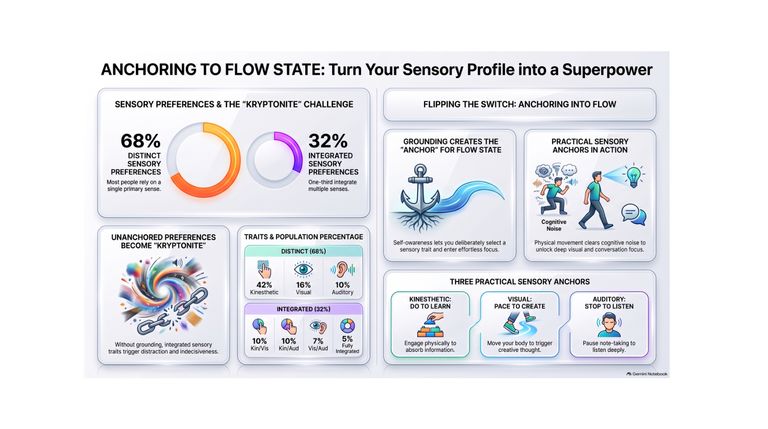
68% of people are “Distinct,” with a single Primary Sensory preference:
- 42% Primary Kinesthetic
- 16% Primary Visual
- 10% Primary Auditory
-
The remaining 32% are “Integrated,” with at least two Primary Sensory preferences:
- 10% Integrated Kinesthetic/Visual
- 10% Integrated Kinesthetic/Auditory
- 7% Integrated Visual/Auditory
- 5% Completely Integrated (all three traits)
I fall in the 10% who are Integrated Kinesthetic/Visual, and I’m also Highly Auditory.
Integrated people have some unusual strengths. They can often align with more Sensory types because they “see” (and/or “hear” and/or “feel”) the world more easily than Distinct types do. But like everything in life, a Superpower can also be Kryptonite. Integrated people can be more easily distracted or indecisive, and they may come across as wishy-washy.
Anchoring
To turn Integrated preferences from Kryptonite into a Superpower, you need to anchor. Anchoring means building the self-awareness to recognize when you prefer each of your Sensory traits. That awareness starts with being grounded. Once you have it, you can figuratively flip a switch in your head, choose a specific trait, and drop into flow.
Flow lets you do remarkable things. Tasks that are normally hard suddenly feel easy, as if you’re doing extraordinary work in slow motion. I’ve found tremendous creativity there.
Discovering My Flow
In 2018, I had the privilege of working with an amazing team at NetApp in Sunnyvale, in the heart of Silicon Valley. As an Organizational Development (OD) professional, I spent most of my time helping my 12,000 colleagues navigate change strategically by building systems and processes, and by motivating a remarkably talented workforce to reach new levels of performance.
My desk was on the third floor of Building 1, in an open-plan space in the northwest corner. In practice, that meant a cubicle with walls high enough to concentrate on complex work. I enjoyed that semi-private space now and then, but it wasn’t how I found focus or dropped into flow.
Luckily, my cubicle was near the very corner of the building. Looking out, I could see the growing “Cloud” companies (Google Cloud, NetApp and others) filling that part of Silicon Valley, with the Santa Cruz Mountains behind them. Between me and that view sat about 200 square feet of glassed-in conference space that was rarely used. So I effectively had a much bigger office, and I made the most of it.
I requested soft furniture for one end of the room, where I could lie down, put my feet up and think. More importantly, the room gave me space. I’d put a flip chart on the empty conference table and start pacing. I quickly found that walking back and forth pushed distractions out of my head (my Kinesthetic side at work). Soon objects, schematics, flow charts and diagrams began filling my mind. I’d work through ideas visually and capture them on the flip chart as diagrams, with only the occasional word or two. Everything slowed down, and I could feel my creativity coursing through me. It almost felt like floating, completely focused on the problem in front of me.
Flipping the Switch
That experience helped me identify my Sensory anchors:
- To learn something, I need to do it (Kinesthetic).
- To have great professional conversations (Auditory), I need to stop taking notes and focus entirely on the person I’m talking to. Here, my Kinesthetic habit of note-taking actually distracts me.
- To be creative, I need to pace, which pushes the noise out of my head so I can draw flow charts and diagrams (Visual).
Now I can drop into flow quickly. I picture myself flipping a switch on the back of my neck, then start pacing (or go for a walk) to tap into my creative, visual side. Learning what anchors you allows you to quickly be much more effective. As J. R. Rim states,
“Flying starts from the ground. The more grounded you are, the higher you fly.”
— Doug Breckenridge, Co-Founder of Vujade™ and Cabo™
Next Week
Your pie charts, bar charts and scatter plots aren’t ready for an AI future. For those of you who love design, Doug marks the first anniversary of Bear Mountain’s Design Patent by sharing how minimalism, extraordinarily complex data and color led to a whole new type of chart—the Vujade™ radial.