Este artículo solo está disponible en inglés.
A Deeper Understanding: 11 Uniquely Visual Monty
· — Monty Miller, Co-Founder of Vujade™ and Cabo™
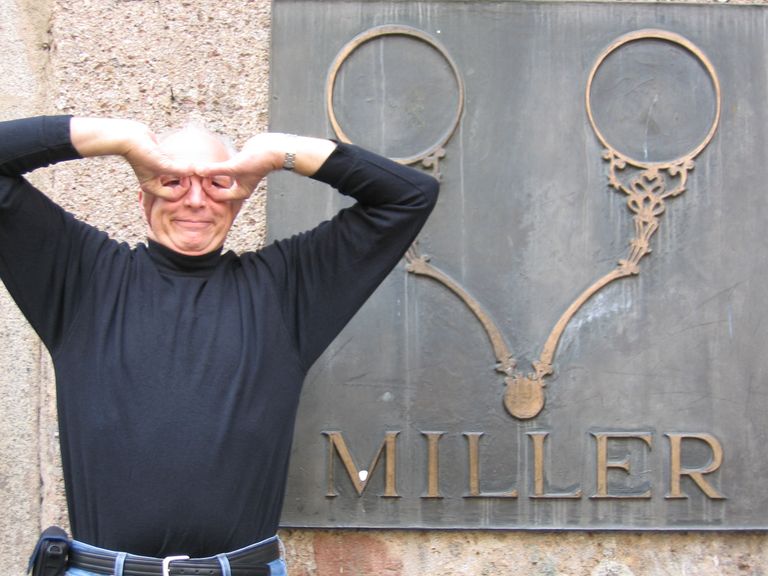
This is Monty, I am extraordinarily Visual—100%! So far, I am the only person on the planet with that score for any sensory construct. Vujade™ measures core traits, not competencies. I score below 1% in both Auditory and Kinesthetic. As I described in my Auditory article, I have learned to activate my listening skills, but they are acquired.
I believe my mother and grandmother were strongly Visual Figure 1. I recall Mom telling the story of a neighbor who stopped by and said, “you know where your son is?” I was 3-4 at the time, walking through the corn stalks and around the cows in November on my way to Grandma and Grandpa’s house half a mile away. Mom’s response was, “y’all I got an eye on him!” Grandma was always taking pictures. Before the digital era, buying and processing film showed real commitment. She sparked my interest in photography before my teens by giving me a Kodak Hawkeye camera, and I began snapping pictures.
Fifty-one years ago, I was a Rotary Exchange Student in Brasil. To prepare for the year abroad, I bought a Canon 35mm single-lens reflex camera. Dad, who was not Visual, flipped out because I spent $450 on it—but I captured a year’s worth of fabulous pictures. I have not stopped since; my devices now hold tens of thousands of photos. I love hiking, skiing, and doing Tai Chi on the beach Figure 2—not so much for the exercise as for the data and steps, plus vistas Figure 3, sunsets Figure 4, mountain ranges Figure 5, wildlife Figures 6, 7, 8, 9, terrain Figure 10, and star-filled skies. In summer, I enjoy watching satellites pass overhead from the deck. Years ago, while walking Domino the Dalmatian Figure 11, I watched the space shuttle approach the International Space Station to dock—an out-of-this-world thrill. When flying, I always choose a window seat for the view below; heading west from Denver is best Figure 12 and sometimes heading east Figure 13!
Enter the AI age and for a year I have used Lightroom to tinker with my photographs and bring out the colors and AI to create an even more dynamic picture – but using AI adds a moral dilemma as some are definitely not grounded in reality and, unfortunately, we can no longer say, “see is believing” Figure 14. My mind is filled with images from the past, and I am happiest when a photo on my phone, iPad, or computer documents a scene and experience.
Mom often experienced pareidolia, seeing animate figures in cliffs, clouds, forests, and elsewhere; I do too. Near home, the Thumb protrudes from Prospect Mountain. Its north side bears a face resembling Alfred Hitchcock Figure 15. And currently with the Aspen turning there is a deer composed of Aspens in the conifers under the Cathedrals, on Twins Sisters Figure 16.
Dad, being highly Kinesthetic, loved to build. I learned to watch him work, anticipate his needs, and place the right tool, part, or item in his hand. We made a complementary team.
Combining my extraordinary Outcome and Visual traits produces interesting results. As a Sales Rep in 1982 introducing the concept of conservation tillage, I took lots of custom photographs of fields, showing before and after results with date, rate and location. I learned the power of facilitation: invite the owner of the field before the meeting to share observations and results, when I came to slide in the meeting, turn it over to her or him and let them share the story. It was powerful! Forty years ago, as a product supervisor in brand marketing, I handled forecasting, pricing, and distribution recommendations for a highly seasonal, half-billion-dollar product line. I was repeatedly recognized for projecting demand of millions of gallons to within 1,000 gallons. In 1984, I was among the first in the business to build Lotus 1-2-3 spreadsheets for trend-line forecasting and low-net-margin analysis; my work prompted the finance team to adopt spreadsheets Figure 17. My predecessor spent a week running down the hallway to gather everyone’s pricing input. That seemed inefficient—and I am also very low Kinesthetic. Instead, one afternoon in the mid-1980s, I gathered the Brand Managers, connected my IBM XT to a large three-bulb red, green, and blue projector, and led a three- to four-hour Lotus 1-2-3 “what if” pricing session. We left with our numbers and projections ready. I believe my longitudinal capacity exceeds most people’s, helping me project further into the future.
When preparing to do something, I often visualize it. I see the goal—the desired outcome—in the distance, with a path leading from the present to the future. Along this path, I identify related issues and needs to weave into the plan for better execution. This often happens with travel: if I need to get from point A to point Z, I incorporate other stops to use my time well and accomplish more.
I am comfortable leading and facilitating sessions from the front of the room. I watch participants’ body language, sense when receptiveness gives way to boredom and adjust the pace and activities. For years, I have called myself a “tree killer” because I use so much flip-chart paper Figure 18 and so many whiteboards. They engage people around a question or topic and let me see their thinking. Seeing and hearing information is far more comprehensible to me than hearing it alone. Yet my Introvert side is equally happy sitting quietly in a far corner of a room, watching and listening.
Reading body language has also gotten me into trouble. As noted in the Auditory article, more than 20 years ago, a TSA screener at the Denver airport motioned with his wand for me to stand and be scanned, so I did. He then yelled, “I did not tell you to go and stand.” I do not recall his exact words, but I clearly remember the motion of his wand.
As I often say, anything with pictures, charts, graphs, data, or body language gets my attention. I am drawn to galleries, exhibits, cemeteries, museums, trade shows, plays, concerts, and movies Figure 19. When reading an article, magazine, newspaper, or online post, my eyes go first to graphics and pictures; they pull me into the text. Then I become a stickler for facts and reality, asking, “Does this look right?” If something conflicts with my understanding, I take a screenshot or photo and use Gemini to check whether it is true or false. I may offend people by challenging posts that do not align with the facts, but my goal is to satisfy my curiosity, share what I find and stress that we need a world of truth.
Many publications now pair written text with audio narration. My comprehension improves greatly when I can see and hear the content.
Perhaps this relates to Neuro-Linguistic Programming: writing about my Visual core traits was far more energizing and enjoyable than exploring my Auditory workarounds. Interesting!