Este artículo solo está disponible en inglés.
A Deeper Understanding: 10 Standard Deviation; Novel Innovation!
· — Doug Breckenridge, Co-Founder of Vujade™ and Cabo™
10: A Deeper Understanding
Standard Deviation; Novel Innovation! (Part three of a three-part series)
Over the last two weeks, I shared my frustrations with traditional assessment instruments in Why HR Doesn't Produce Many Patents, and the limits of additive surveys in Right Place, Right Time, Wrong Answer, Right Question.
What I discovered was a different kind of assessment model: a comparative assessment built on standard deviation.
Standard Deviation?!
Most of us grew up with the additive model in school: the more correct answers you gave, the higher your grade. If everyone answered 100% correctly, everyone earned an "A." But every so often we'd hear the phrase "this class is graded on a curve," and a shiver would run down our spines.
The curve, also known as the Bell Curve, meant most students would land at a "C." The next largest groups would be an equal number of "B's" and "D's," followed by a very small share of "A's" and "E’s/F's (or Fails)."
Many students felt this was unfair. You could know the material very well, score just slightly below a handful of classmates, and still end up with a "C." In highly competitive education systems, a "C" can feel like a death knell, which is why whole industries grew up around standardized testing to help students stand out.
The Real World
In the corporate world, we typically face two types of assessments:
- Skills or competency testing
- Personality and behavioral testing
For the former, additive testing makes sense because it measures whether you can complete a task. The latter is far more complicated. Much of the analysis reflects preferences, not competencies, and in hiring, selecting for a personality can feel discriminatory. (And while it may even point to where someone's highest competencies lie, but it's no guarantee.)
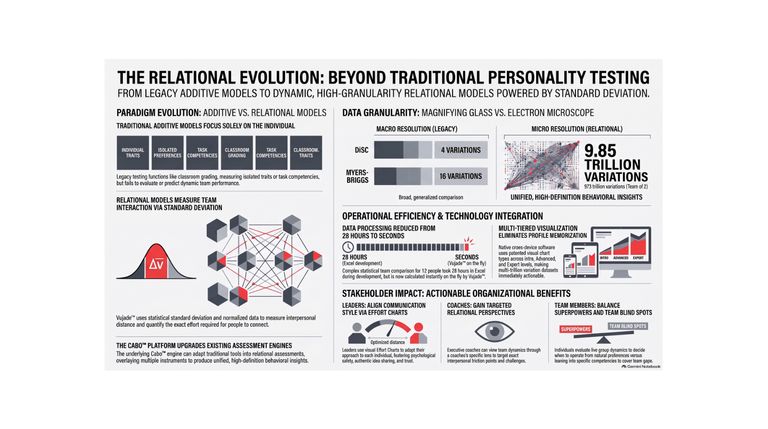
What matters in business is less the individual and more how the team performs. Hiring great individuals may create a dream team, but team results drive most corporate outcomes. Understanding team dynamics is therefore vital, and additive instruments fail miserably at it. Relational instruments are needed.
The How
Standard deviation needs data. It's hard to build a distribution from a single data point, so the first step was building a population. In traditional statistics, a 90% confidence level with a ±10% margin of error calls for a sample of about 68 people. Working with my business partner, Monty Miller, we developed our first survey and built that population.
I'd love to say the numbers crunched perfectly. They didn't. As we added testers and revised the survey, I found I couldn't apply standard deviation broadly; I had to normalize how people answered. That demanded new perspectives and far more advanced statistical tools, and it's part of the secret sauce behind our second US patent. We are now on the fourth version of our survey, after more than three years of validation with our alpha and beta testers.
The Wow
One of our main goals was to gather lots of data. The more granular it is, the more ways we can differentiate individuals, both across types and within the same type. This depth lets us accurately plot people on a quadrant that measures differences, or express how much effort it takes to connect with another person. How does that compare with traditional instruments?
More data may seem intimidating at first, but it opens up a whole new world. Traditional assessments are like looking through a magnifying glass; relational assessments are like using an electron microscope. The fun of this journey is that the added detail lets you ask entirely new questions, because you can observe individual and group dynamics in new ways. (Consider Watson and Crick's discovery of DNA's structure. Think how different our world became once we could analyze life at that level: mapping the human genome, cures tailored to genetics, and more.)
Vujade™ is the first instrument to emerge from this shift. The engine beneath it, the Cabo™ Platform, can power traditional assessment tools with only slight modifications to their survey mechanisms, converting them to a relational assessment tool giving them the same granularity and much more value. Once on Cabo™, multiple tools can overlay one another for a richer understanding of individuals and human behavior.
****
The Pow
With so much data, the natural worry is being overwhelmed. Fortunately, technology has advanced to such a level to overcome those concerns. While building the model, I did my research and analysis in Microsoft Excel, where constructing a team comparison for 12 people took roughly 28 hours. Today, Vujade™ does those calculations in seconds, on the fly.
The next concern is interpretation. We've addressed it with multiple user levels (Intro, Advanced, and Expert) and entirely new chart types that make complex data easy to visualize. (That's another story, and the subject of our first US Design Patent.)
With this progress, I reached a simple conclusion: we no longer have to memorize people's profiles, because nearly all of us carry a powerful computer with us. Vujade™ works across phones, tablets, and computers. We can get very detailed without worrying about memorization, and the details can be actionable.
Vujade™ helps people communicate better with others:
- If you're a leader (or aspire to be one): Effort Charts show you how to align your communication style with each team member. That helps them feel comfortable expressing themselves, which leads to more authentic ideas, greater engagement, and eventually trust.
- If you're a coach: Select a team member and see the world through their eyes, including the specific challenges they face when interacting with their team. That leads to coaching tailored to their unique circumstances.
- If you're a team member: Look at team dynamics to decide whether to act from your Superpowers (your preferences) or to lean on a competency and take a different role, preventing a significant team blind spot.
The Now
The world has shifted. We can better understand not only how we behave, but also how others behave and how teams function. I don’t have the hubris to take credit for this amazing journey I’ve been on…many of our best ideas have come from our Alpha and Beta testers. I am thankful for their candor. I’d love to hear your ideas as we continue on this journey!
— Doug Breckenridge, Co-Founder of Vujade™ and Cabo™