
Este artículo solo está disponible en inglés.
A Deeper Understanding: 09 Right Place, Right Time, Wrong Answer, Right Question!
· — Doug Breckenridge, Co-Founder of Vujade™ and Cabo™
09: A Deeper Understanding
Right Place, Right Time, Wrong Answer, Right Question (Part two of a three-part series)
In last week's article, Why HR Doesn't Produce Many Patents, I shared my frustrations with traditional assessment instruments. Specifically, I pointed to:
- Their tendency to sort people into stereotypical categories (aka "boxes"),
- Their vague, broadly applicable guidance (the Barnum-Forer effect),
- Their significant bias — baked into both the design and the "additive" methodology used to construct and score them, and
- Their inability, as a result, to offer meaningful comparisons between individuals and teams
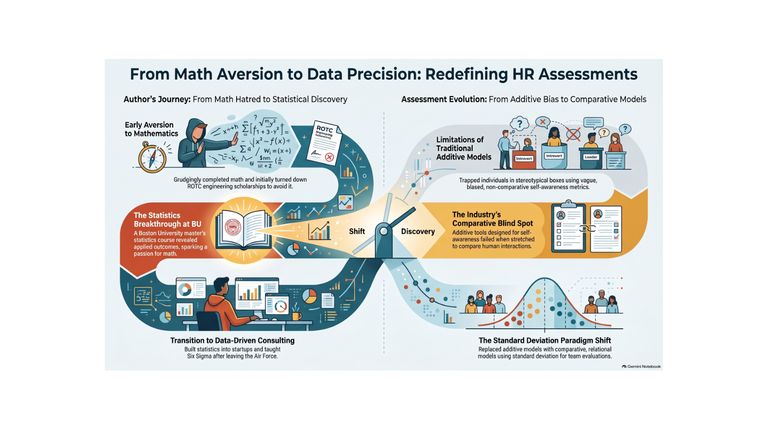
After two years of trying to mitigate these limitations, I was still stuck. Then, while turning over that last bullet — the trouble with comparing people — I had a realization: the additive model itself couldn't produce comparative data. It wasn't a matter of refining the model further; the model had simply run its course. These assessments were built to give individuals self-awareness, not to compare people to one another. The moment you try to use them for comparison, bias creeps in. As these traditional models grew popular, their designers stretched them to explain human interaction — but given how they were built, that stretch never quite worked. The assessment industry had a blind spot.
I think of it like a society that only has cars — no air travel. If people in that society want to get somewhere faster, they build a bigger engine, make the vehicle more aerodynamic, and/or lighten the load. Those changes help, but only to a point. Push a car fast enough and it becomes unsafe, and no amount of engineering lets it cross an ocean. To travel long distances quickly, you need a fundamentally different approach — an airplane. And building one requires a lot of math and engineering. **** Math. Ugh!
I was a decent student growing up, fortunate to attend strong public schools in Detroit and Farmington Hills, Michigan. Most of my teachers were genuinely passionate about their subjects and their students:
- I built a love of reading thanks to Phyllis Jackson, who challenged me to read every book in our elementary school library, and Rita Pieron, who turned Shakespeare from baffling phrases into meaningful reflections on the human condition.
- Physics gave me the scientific method and a taste for experimentation, thanks to Tom Krupka.
- History became a passion through family vacations and teachers like Mr. Hayek and Mr. Beardsley.
- Music mentors — Grant Hoemke, Margaret Koltz, and Paul Barber — gave me a lasting appreciation for art and culture.
- And math? I had excellent teachers, like Mrs. Miner and Miss Jackson, but no spark ever caught. I could do the work — just grudgingly.
The year before college, my mother was laid off. I earned some scholarships, but not enough to cover all my college tuition. Exploring my options, I applied for an Air Force ROTC scholarship at Michigan State, intending to study International Relations at James Madison College. In my interview, the Air Force offered me a full four-year scholarship on the spot — with one condition: I had to study engineering, since that's what they needed. I couldn't bring myself to accept. I thought I was finally done with math. I turned down the scholarship but still joined the Air Force ROTC unit at MSU. (Fortunately, my GPA later earned me a full non-technical scholarship for my last two years.) And due to policy changes while was in in Air Force ROTC, I was required kto take Calculus, which I completed without much enthusiasm.
Suffice it to say, I hated math!
After being commissioned as a USAF officer, I was stationed first in Sicily, then England. I. requested the UK assignment to stay in Ground Launched Cruise Missiles (GLCM) and to pursue a strong master's program. The Air Force was excellent about encouraging officers and NCOs toward higher education, though remote postings usually limited access to top programs — this was well before online learning existed. Being stationed an hour outside London opened a different door: Boston University's overseas campus offered a master's in Management, with leading professors, including financial experts from London's "City," the UK's answer to Wall Street.
The program required a statistics course. Taking it at the end of my first year turned out to be life-changing. Suddenly, math made sense — because I could apply it and see a real outcome, I dove into understanding the mechanics of statistical theory. I fell in love with math.
Looking back, I sometimes feel a pang of regret. It wasn't that my math teachers lacked skill — no one had simply shown me math in a way that clicked. I wonder how different things might have looked if I'd encountered statistics earlier. I might have been a far more dedicated math student.
Still, even in my mid-twenties, that moment sparked a lifelong love affair with math. After leaving the Air Force and starting an Organizational Development (OD) consulting firm, I sought out data everywhere. That instinct eventually led me to teach Six Sigma for Motorola University and to build statistics into every startup I touched. **** HR and Math
After nearly forty years in OD, I've noticed that most people in this field aren't especially comfortable with numbers. That's not to say there aren't excellent quantitative minds in the space — particularly in academia and among HR data scientists. But they're a small group compared to the much larger majority drawn to the field for its qualitative, relational work.
That gap is exactly where the opportunity lived. HR has lagged behind fields like finance and marketing in applying statistics. Call it serendipity or dumb luck, but I happened to be in the right place at the right time — not because I'd found the right answer, but because I'd finally stepped back far enough to ask the right question. **** Out-of-the-Box Thinking Leads to the Right Question
Once I stepped back from the problem — the inherent limits of traditional additive assessments — the answer became clear: I needed to build a model that was comparative, not additive. My goal wasn't just to improve self-awareness the way earlier models had, but to make it possible to accurately compare individuals and teams.
Framing the problem this way, combined with my love of statistics, pointed me toward the obvious tool: a comparative, relational model using standard deviation.
— Doug Breckenridge, Co-Founder of Vujade™ and Cabo™ Next Week
Doug describes how standard deviation creates an explosion of comparative data and how Vujade™ and Cabo™ were developed to operationalize data leading to Bear Mountain’s second US patent.